

Key things to discuss
Tl;dr: NVDA earnings were strong but not what matters this quarter. The strategy shift could reduce financing support for AI datacenters, creating a headwind to US GDP growth into next year. The Fed should be patient given these risks but will likely move to raise interest rates instead. Equity markets can rally into month-end after Friday’s option expiry, but December will likely remain choppy. Duration looks increasingly attractive, as does gold.
NVDA’s earnings were a blowout — why’s the stock down?
Since the beginning of October, NVDA traded down -32% vs. SOX at -25%, a -7% underperformance largely stemming from Jensen Huang resigning as CEO amid allegations of affairs and potential entrapment. While SOX is off the 11/05 lows, NVDA continues to move lower and has fallen another 3% since reporting earnings (as of midday PST on 11/18/26), despite a solid beat and raise to FY 2028 numbers.
Let’s unpack what happened to understand how NVDA’s results in the context of what was much more on mind for investors: how NVDA’s strategy will evolve without Jensen at the helm.
Going into the print, consensus for F3Q27 was $109bn in total sales and $2.47 adj. diluted EPS. The key segments were expected to come in at $101.8bn for data center (53.4bn for hyperscale and 48.5bn for ACIE). F4Q27 estimates were $125bn for total sales, $2.75 adj. EPS, and $118bn for data center (61.7bn for hyperscale, 56bn for ACIE).
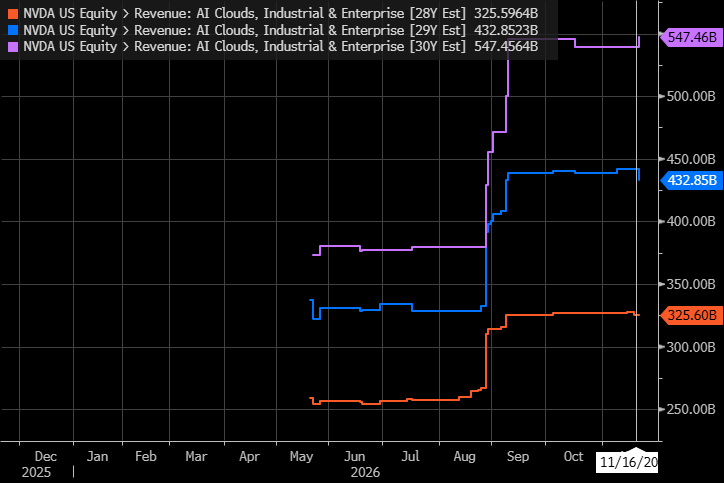
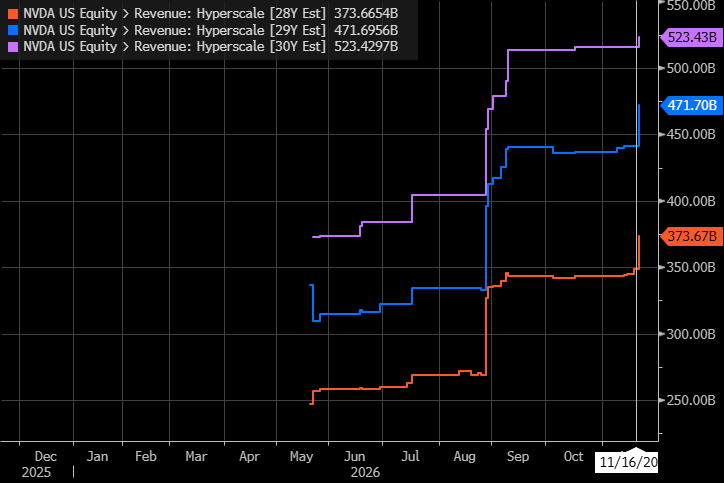
For FY2028 (we are Q4 FY 2027 for NVDA, FYI), total sales were expected to be $700bn — in-line with Jensen’s comments last quarter of 70% yoy growth (on “100%" yoy growth of demand). Data center revenue in the year was expected to be $670bn, with hyperscale sales of 344bn and ACIE of 327bn.
What NVDA reported was a solid beat — $115bn in total sales for F3Q27 (vs. $109bn expected) and adj. EPS of $2.70 (vs. $2.47). Data center revenue led the beat, coming in at $107bn vs. the $101.8bn expected. Hyperscale revenue came in at 60.1bn vs. 53.4bn expected, and ACIE was 47.5bn vs. 48.5bn expected. The miss in ACIE is very important and may be a sign of what is to come.
Backdrop on strategy:
The strategy that NVDA ran rested on an aggressive five pronged approach: (1) lock up supply to limit competitors’ ability to scale, (2) finance hyperscale competitors (“ACIE” is AI Clouds, Industrials, & Enterprises) to improve margin, (3) invest in end markets to pull forward demand, (4) support global AI demand through global datacenter capacity support, and (5) expansion into a platform to enable component substitution.
Almost directly out of Michael Porter, the strategy was smart and Jensen was able to run it aggressively. Each point helped boost NVDA’s position within the ecosystem and allowed it to retain power. Though this power had been waning this year with rising interest in AMD rack solutions and XPU/TPU systems from AVGO and MRVL, these were still seen as “out-year concerns” in that they would still take another 1-2 years to show up.
However, the strategy and outlook articulated by interim CEO Collette Kress (who did a great job, though she and IR misunderstood the market concern) presented an important shift that has wide implications across the AI Infrastructure trade and Macro outlook.
(a) Going into the print, many investors (including us) were hoping management would “kitchen sink” the quarter, by bringing down expectations and derisking FY 2028 through something like a suspension of guidance until a new CEO was selected. While this would have resulted in short term pain (stock down day of), it would have opened the door for investors to jump back in due to “beatable expectations” (a simplification of a thesis, but this would also boost trust with investors).
(b) Kress made it clear that NVDA’s role as the central bank of AI would be disciplined. To what degree, we do not know yet, though we know she was more skeptical of the types of financing NVDA was engaging in. But her comments also suggested that NVDA would prioritize shareholder returns and supporting suppliers, which means NVDA will be taking more supplier risk just as the cycle may be near a turning point.
…So, let me clarify for you, Jim, where we stand in terms of returning capital to shareholders. Super top priority for us, first and foremost, to understand…
…The top priority is going to be our suppliers. Our suppliers are working feverishly to build more demand for us. And some of that demand needs assistance -- excuse me, some of that supply needs assistance in terms of capital from any forms of different types of prepaids to help them in terms of capacity. We want to make sure that we’re there for them, so they can move as quickly as possible. I think that is a very great use of our capital to help support that part of it. Additionally, there are areas where we will see some of our expected committed investments that we need to make that we may need finished. Not a very large piece of it, but something that we need to do.
When you think about just on the edge of a set of types of very strong customers that may need assistance in terms of financing of some type of guarantee, that is something we will do. It is a process that we will look very deeply in terms of the company, the strength of what they have planned, as well as everything that they need in terms of that data center to do so. So, there will be a portion that we will do. But again, something other, a lot of work to understand if those are the right types of investments that we need to make.
(c) NVDA’s out year expectation (2028-2030+) was that hyperscale customers would invest more and more in their own customer silicon (TPU/XPU) like Google with Ironwood TPUs and Amazon with Trainium, that they would then sell to their customers. Jensen’s strategy to mitigate this was to boost the ACIE segment, which is comprised of neoclouds (Coreweave, Nebius, SpaceX), enterprise customers (e.g. companies that run their own private clouds), and sovereigns (UAE, etc.). A tightening of credit to ACIE (customers in need of financing) incrementally tracks against that outcome and means NVDA will likely be more beholden to hyperscale customers in out-years, eroding market share and margins. NVDA’s miss in the qtr of the ACIE segment supports the tightening thesis that poorer credit conditions will drive weaker ACIE growth.
How did estimates move after the print? ACIE estimates down in FY28 and FY29, though up in FY30:
Hyperscale revenue estimates rose significantly:
(d) Investors are increasingly skeptical of further AI capex investment:
Bofa’s recent fund manager survey found that a net 12% of managers were overweight tech, down from 37% in October. More importantly, 52% of managers expect an AI hyperscaler to announce a capex cut within 6 months, up from 30% in October. This suggests investors are unwilling to underwrite estimates at these levels and expect downward revisions to start some time over the next two quarters. P/Es can move lower in this environment!
Brad Gerstner at the Tomorrow X summit implied that AI labs don’t need as much compute to generate revenue. He said 26% of Anthropic’s compute budget went to paying customers in the first 9 months of 2026, or roughly ~500mw of its total 2gw capacity. “So when you hear all of this concern about data centers and this and that, they just don’t need that much compute to hit their numbers for next year.” This suggests AI labs will have much more pricing power vs. chip suppliers and even hyperscalers next year. The large war chests that Anthropic and OpenAI have put together give them the optionality to mix for revenue or training depending on market conditions. We understand why investors are very interested in these two, at the cost of AI infrastructure.
(e) The Democrat sweep and rise of anti-datacenter sentiment is going to marginally reduce the number of projects that are approved. We estimate about ~20% of projects cumulatively through 2030 are at risk. AI Infra stocks that are down significantly are anticipating a downward revision to estimates (which have not happened en masse yet) as unit shipments decline and overcapacity (+ overbuilding) will weigh on ASP and margins. Again, P/Es can move lower in this environment!
(d) Higher financing costs are limiting the size and scale of many projects. Some neoclouds have moved to term out their debt (CRWV & ORCL) while others still need to (NBIS).
All of this represents a significant shift in the outlook for AI Infrastructure, with NVDA’s strategy shift (tighter credit for customers, greater hyperscale dependency, supplier financing) an important inflection. Now, one quarter doesn’t make a trend, and our goal isn’t to suggest we are headed for a doomsday scenario with NVDA back down to pre-AI levels. Instead, we see these factors driving the stock in the near-term, with uncertainty keeping it range bound until more clarity emerges on the path the company is taking.
Scenarios for NVDA:
If we progress into credit tightening + more hyperscale dependency + more supplier financing => stock will trade lower and lower as we begin a downward revision cycle.
If management bring on a star CEO who improves the strategy to boost credit expansion + ACIE business + less supplier financing => stock can begin to trade sustainably higher with buy side estimates stabilizing.
Some great graphics illustrating the role NVDA plays in the AI ecosystem:
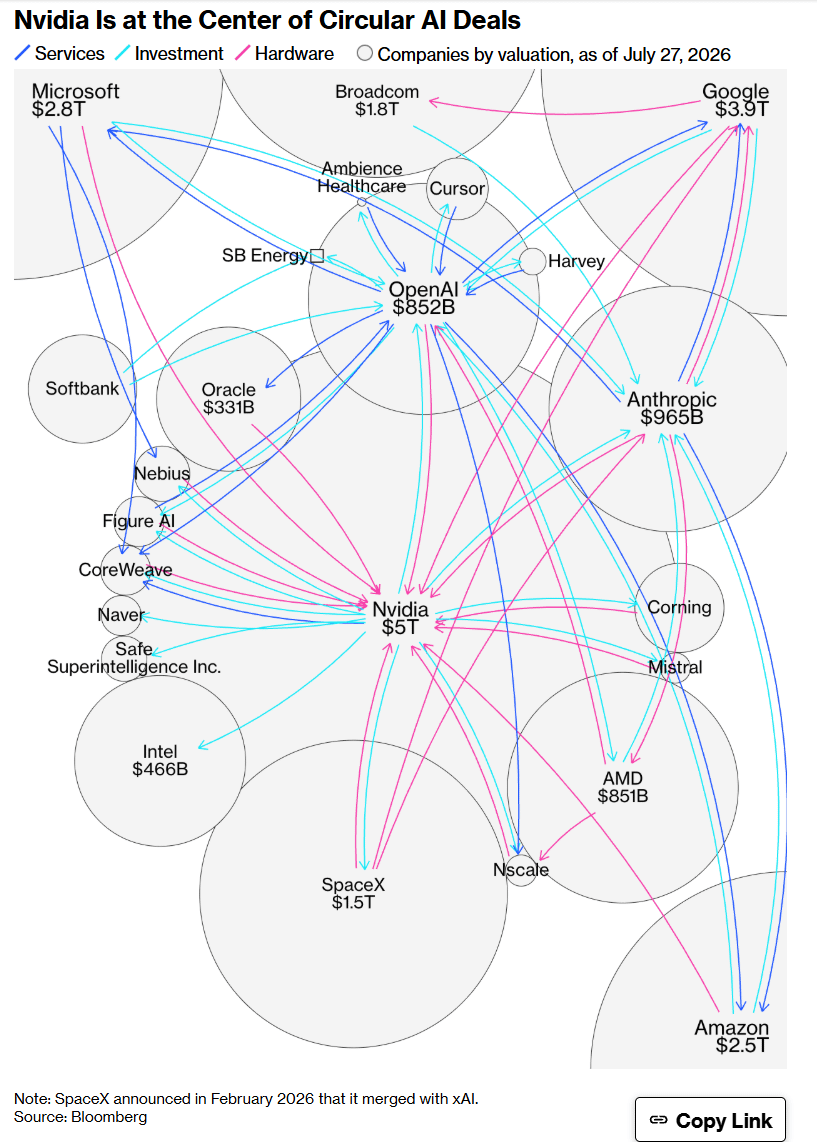
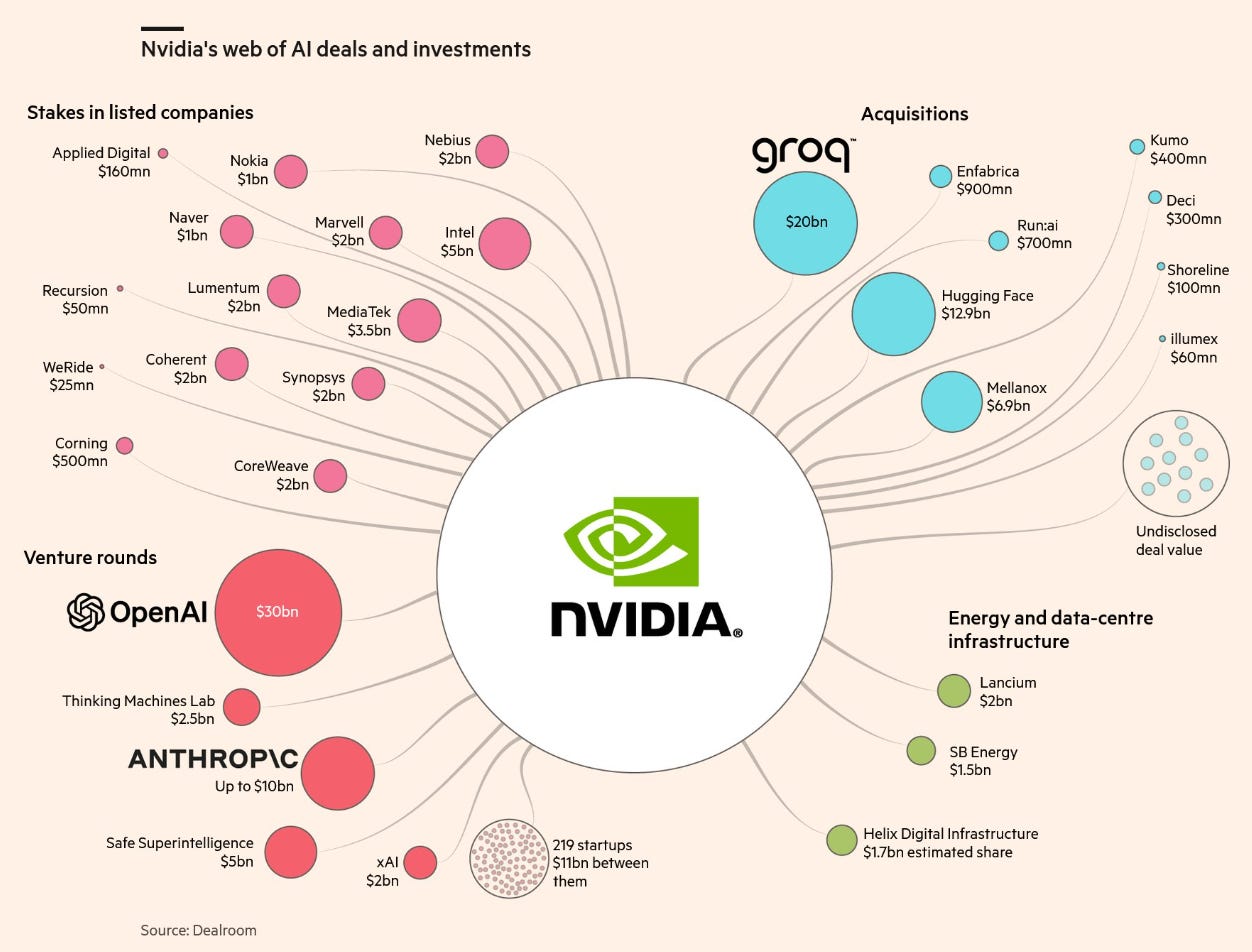
Note: none of these illustrate the credit backstop NVDA is providing to $500bn of private credit financing.
What are the Macro implications of NVDA’s strategy change?
We see NVDA’s credit tightening as a downward revision to the credit backstop supporting much of the AI datacenter buildout. Blackstone’s Jon Grey reiterated his company’s push to finance these projects, though said recently at a conference in Hong Kong that more equity capital while be needed to bridge the funding gap. Mark Rowan at Apollo, another major private credit financier of AI datacenters, suggested that underwriting discipline will need to tighten.
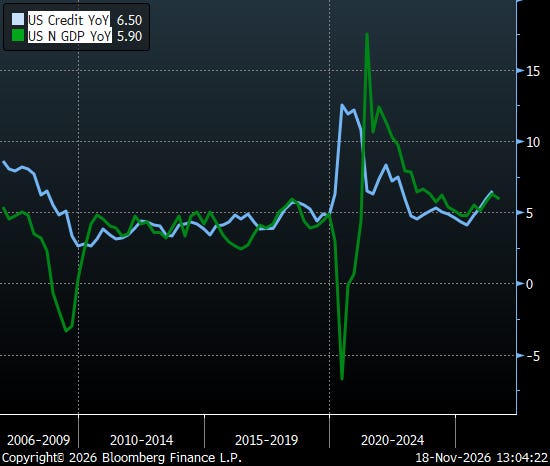
Incrementally, we see these comments as supporting a slowdown in credit expansion in the US. The pace of credit creation has helped support US nominal GDP of 5-6% and is one of the drivers behind higher levels of inflation (growth driver of inflation).
The Fed gave their Summery of Economic Projections during the FOMC meeting in September, with a new set of expectations due in December.
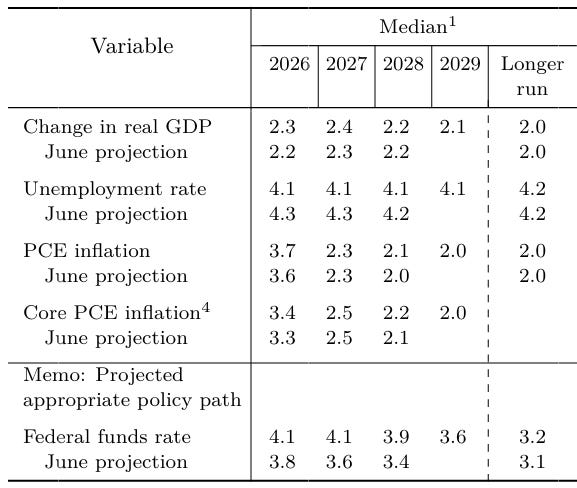
The street largely agrees with their outlook — putting 2027 and 2028 real GDP forecasts within 0.1pt of Fed estimates.
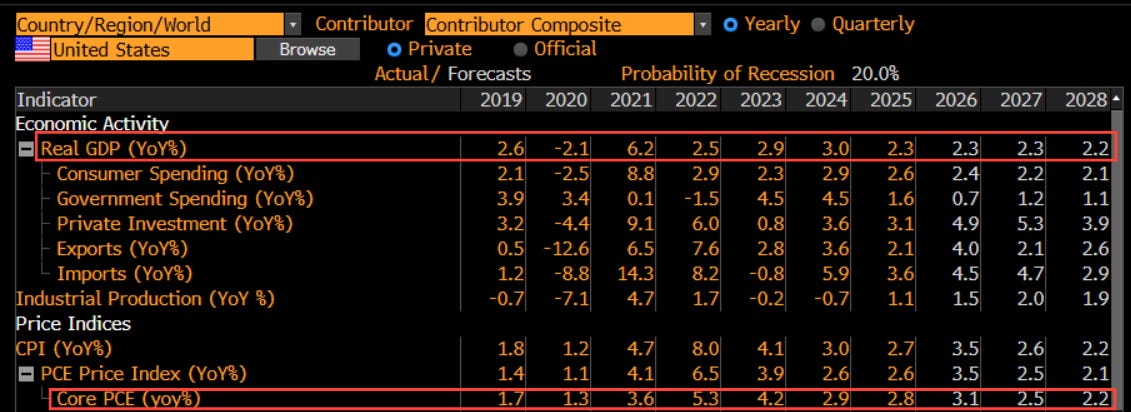
In the consensus forecasts, a key driver of growth in 2027 and 2028 is private investment — growing 5.3% in ‘27 and 3.9% in ‘28. Given that this growth is largely driven by the AI infrastructure & datacenter boom, the waning risk appetite from investors suggests that growth estimates are too high and will need to come down.
How should the Fed think about this?
We think the Fed should move towards greater patience here, despite what will likely be a blistering Q4 ‘26 and Q1 ‘27. This is because the economy is slow-moving and we estimate the slowdown in projects will only begin to show up in data by Q2 of next year. Adding a rate hike, or a surprise 50bp at Waller suggested, only increases the odds of a mistake.
Could credit expand without NVDA’s backstop?
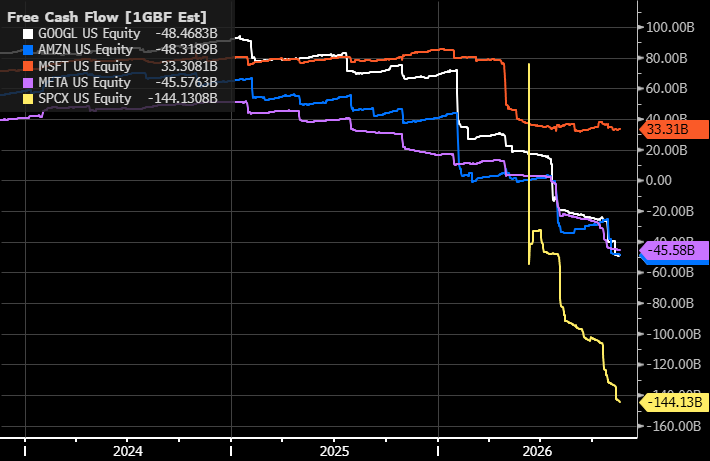
We think it is unlikely that credit expansion continues at this pace through next year, and that a deceleration is imminent by Q2 2027 if not sooner. This is because available pools of capital, such as hyperscalers and private credit have already committed substantial capital. Hyperscalers are moving into negative FCF over the next few years as they ramp up AI infra projects, with the exception of MSFT.
Forward 12-month FCF of hyperscalers + META + SPCX:
What about private credit?
While Apollo, Blackstone, and others seem willing to finance the build out, we believe the removal of more explicit NVDA guarantees increasing the risk of each subsequent deal. Our current view is that there will be a marginal detraction (10-20% fewer deals approved) versus a wholesale collapse (funding markets dry up), which will show up as slowing total credit creation and in SLOOS as a tightening of standards.
Cross-Asset Views Into Year End
The market, and economy, is dynamic and any type of static analysis is unlikely to age well. However, we think it is worthwhile to still outline the various scenarios and outcomes to anticipate. Near-term, we think equities can bounce post-Friday’s Option Reg Expiry into November month end.
Scenario 1 - Baseline view
Credit conditions soften into year-end, with financial conditions averaging tighter than in Q3.
Fed hikes interest rates by 25bp and suggests each meeting is live, shifting tone from prior implied quarterly cadence.
Cross-Asset Impacts
SPX outperforms vs. NDX, driven by a further rotation out of Info Tech and into non-cyclicals (Healthcare, Staples, and opportunistic early cycle like housing).
Yield curve flattens, front end higher by 25-50bp, while long end comes down, US 10yr ends the year below 5%.
Dollar neutral, gold bid into year-end.
Scenario 2 - Hawkish Surprise
Credit conditions soften into year-end, with financial conditions averaging tighter than in Q3.
Fed does a surprise 50bp hike, implying one and done.
Cross-Asset Impacts
SPX and NDX down significantly.
Yield curve inverts, market begins to price in rate cuts by summer of 2027.
Dollar sold, gold bid into year-end.
Scenario 3 - Steady Going
Credit conditions stabilize, with financial conditions marginally easing through the quarter.
Fed hikes by 25bp and communicates patience.
Cross-Asset Impacts
SPX and NDX higher by year-end.
Yield curve marginally flattens, WIRP for end of 2027 remains >2, though US 10Yr up to 5.2%+ range.
Dollar bid, gold sold.
Let me know what you think.
If you’re an investor, investment professional, have domain expertise in these topics (AI, software development, project finance, private credit, semiconductors, etc.) please reach out and introduce yourself.
Muhammad Wahdy
Portfolio Manager
Wahdy Capital
Disclaimer
The views expressed herein are solely those of the author and are provided for informational and educational purposes only; they do not constitute investment advice, an offer, or a recommendation to buy or sell any security. Information is derived from sources believed to be reliable but is not guaranteed as to accuracy or completeness, and opinions are subject to change without notice. Investing involves risk, including possible loss of capital, and past performance is not indicative of future results. Readers should consult their own financial, legal, tax, and other advisors before making any investment decision.