

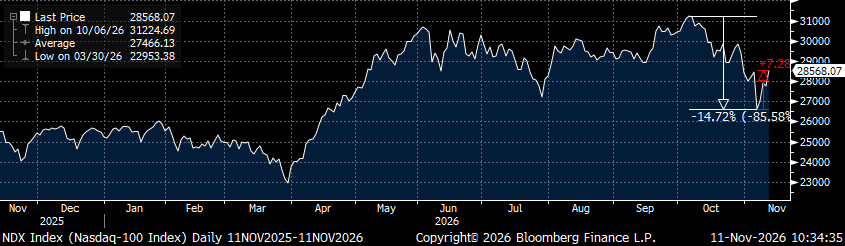
After a pretty intense 4 weeks, which saw the NDX drop nearly 15%, we’re bouncing off the lows, and the AI trade seems to be back on. But what happened, has anything changed, and where do we go from here?
What happened
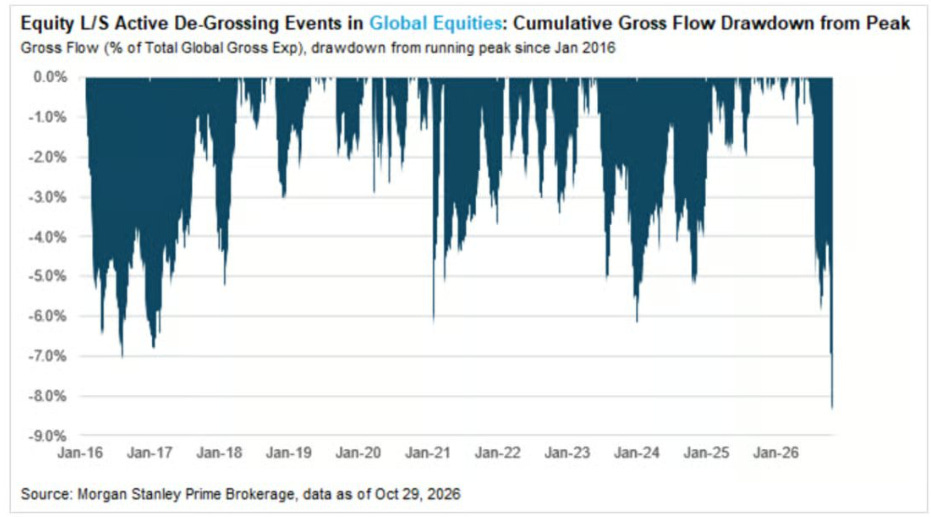
Largely, the October-November correction seems to have been driven by: (1) an unwind of bets stemming from losses in rates and credit, (2) equity transmission first through Neocloud and funding sensitive sectors, and then subsequent (3) broad deleveraging (hedge fund degrossing, long sales, etc.).
In the midst of this, several AI thematic incrementals also emerged: (4) Anthropic’s annualized recurring revenue, once stripped of Meta and distillation revenues, came in below expectations, (5) AI lab token growth peak concerns, and (6) reports of CIO budgets being under greater scrutiny to optimize AI spend.
If that wasn’t enough, in the AI infrastructure/hardware space, we had: (7) Jensen Huang out as CEO of NVidia, (8) rumors of Nvidia cuts to TSMC orders amid excess inventory & lost SEA market, (9) Anthropic’s “Mythos moment” to chips from its software porting capabilities.
And then of course, there is the elephant in the room — (10) a Democrat sweep of the house and senate, along with gubernatorial and state chamber victories, could create a more hostile environment for new data center development.
Analysis
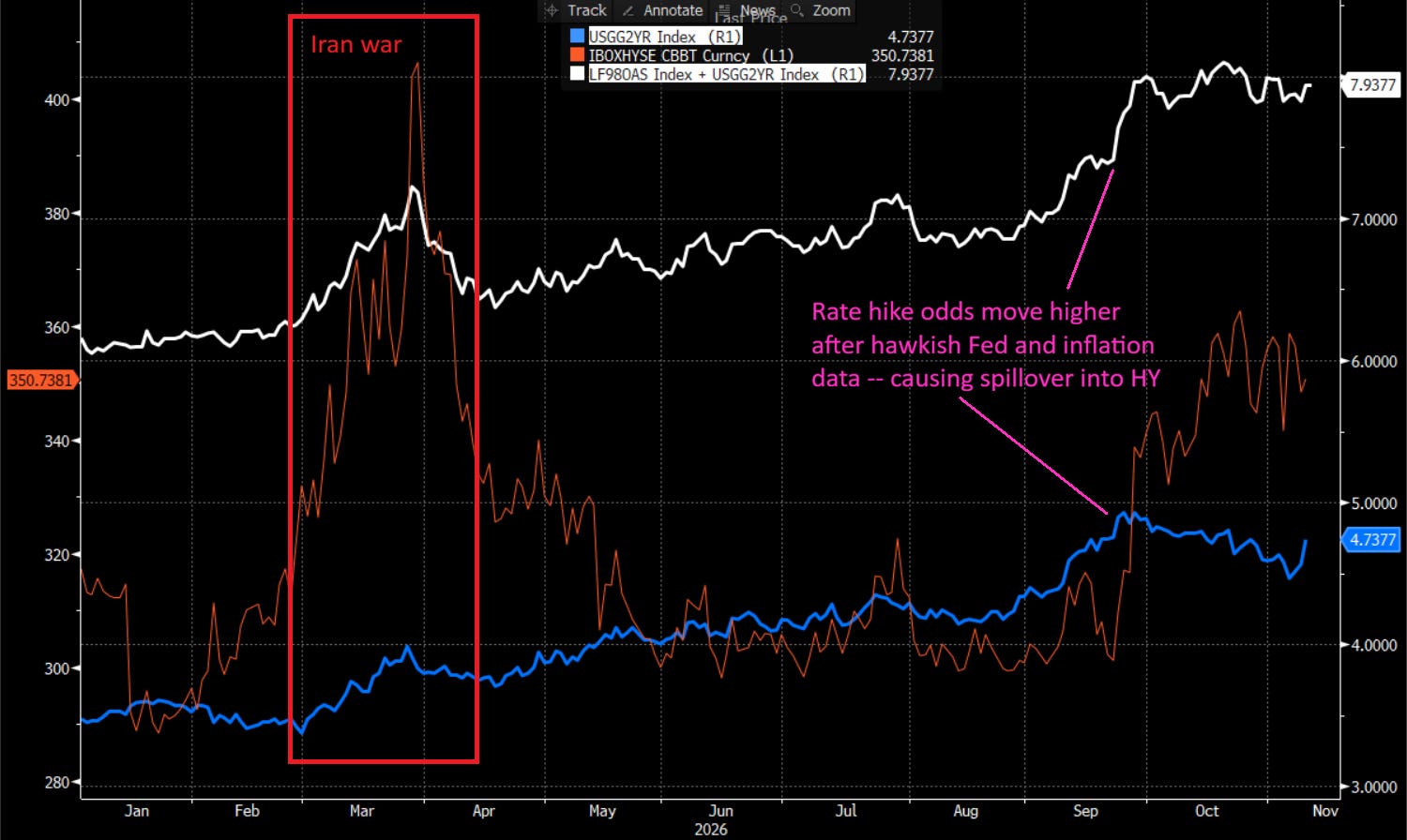
(1) Losses in Credit and Rates sparked the initial wave of turbulence. Here we chart the US 2 year note vs. HY OAS (+2y so you can see an approx. of the level, in white) vs. HY CDX. Our understanding is that Warsh’s Jackson Hole pivot, and subsequent hotter inflation indicators, drove losses in rates and credit as yields surged 55bp on the US10yr between the end of August and early October).
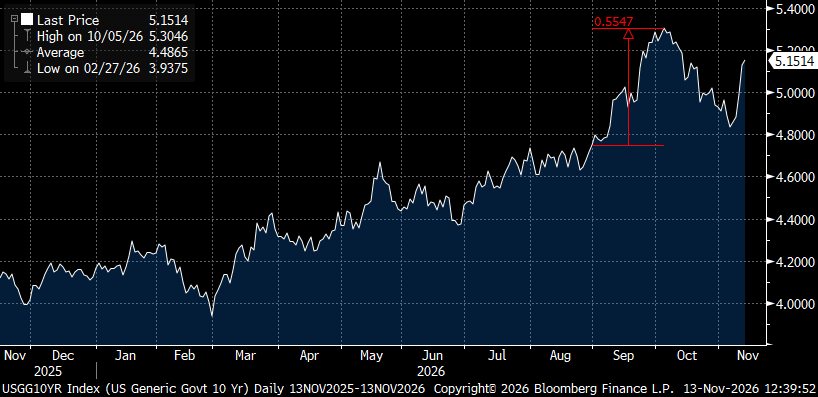
The move in US 10 Year Yields was intense — 55bp from 8/31 to 10/5:
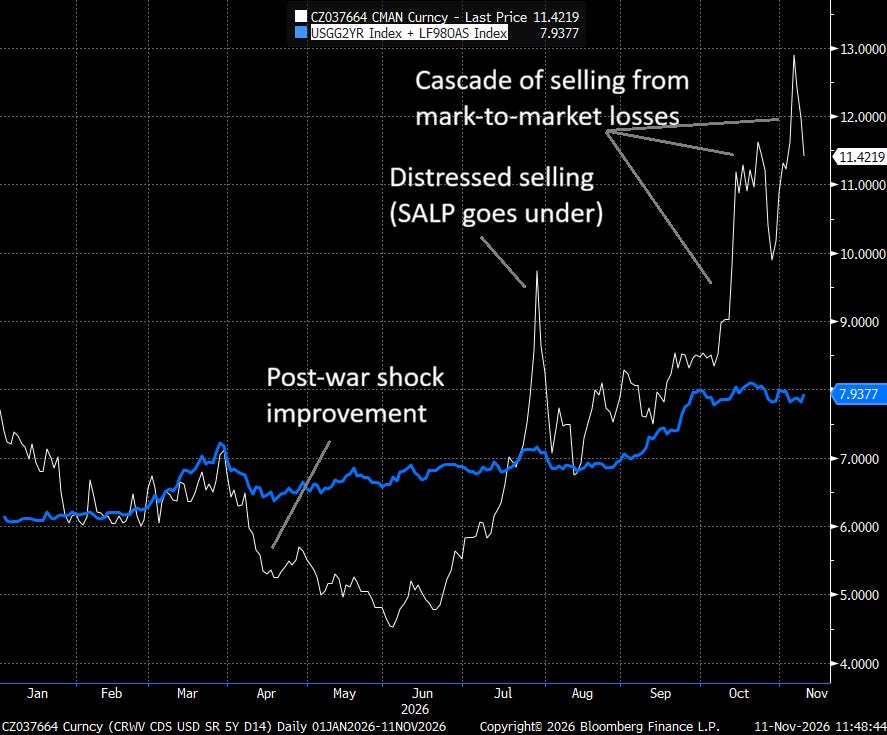
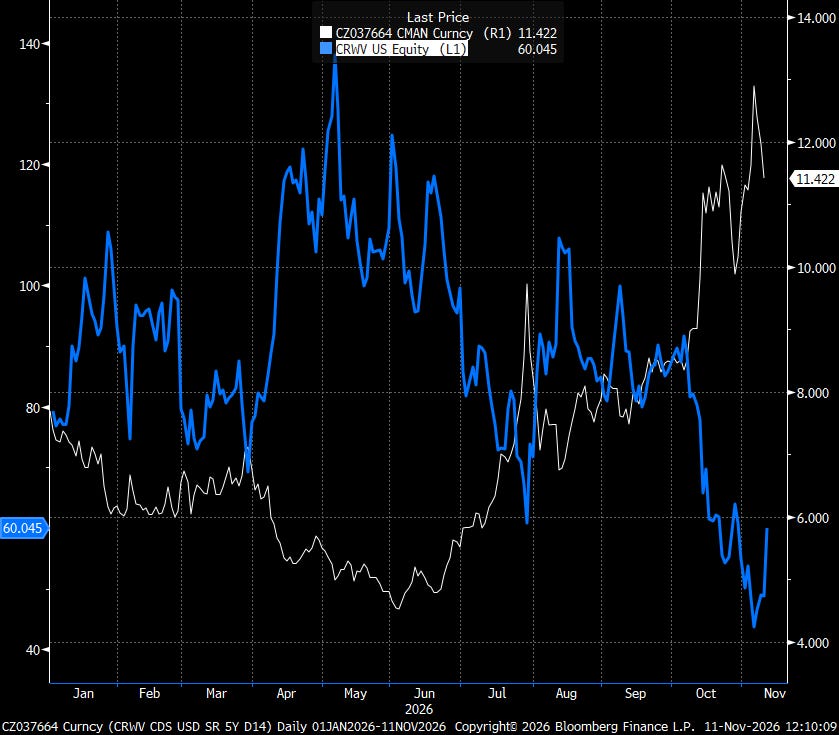
(2) The neocloud / credit transmission is best seen through 5-year CDS spreads on Coreweave’s debt (poster-child of debt financing for AI data centers). When interest rates rise, the value of bonds fall and incur paper losses for investors. Our understanding is that a mix of equity and credit teams at multi-managers had bought neocloud/AI HY credit and, that as 1H profits turned into 2H losses, were stopped out (liquidated/fired). Multi-managers with tight risk limits create forced-selling pressure if the losses exceed a certain threshold, similar to a margin call. This spills over into equities as the implied funding rate for the company rises and diminishes future earnings (e.g. if the prior cost of capital was 10% but jumped up to 15%, a 15% unlevered IRR project sees its economic spread compress from 500bp to zero).
We can see the impact to Coreweave’s stock price (LHS), almost mirroring CDS (RHS):
The performance of companies with funding and financing needs underperformed QQQs and SOX Index:

(3) With losses rising, hedge funds delevered/degrossed to protect capital:
How true is this?
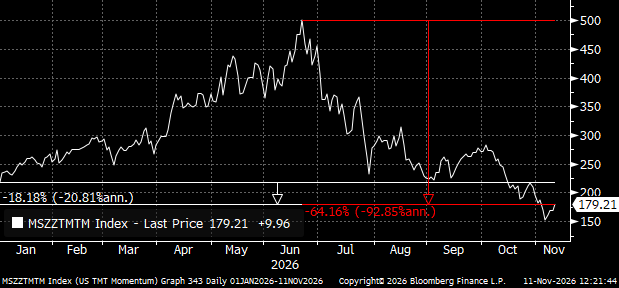
We think this is a good way to understand what happened. It does not explain all of the issues and doesn’t provide all the background (e.g. crowding into AI names, prior hedge fund deleveraging cycles, complete meltdown of US TMT Momentum). But the fundamental transmission is the rates shock —> credit impairment —> equity losses.
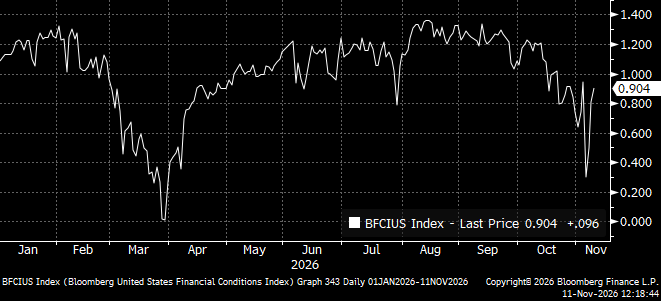
Another lens to evaluate this is through financial conditions, which also supports the rates to credit to equity transmission.
Bloomberg’s Financial Conditions index fell nearly to Iran-war shock levels:
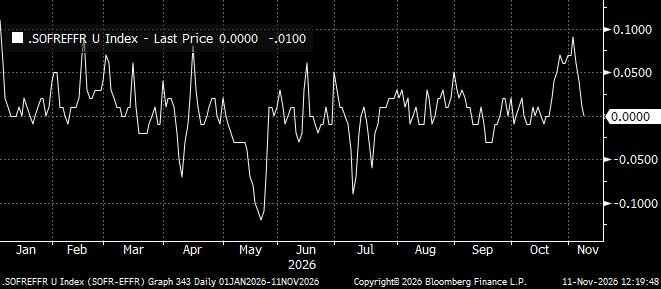
SOFR-EFFR widened dramatically in late October, led by repo, which may have exacerbated the moves in equities. Note: this happens primarily due to TGA/Treasury activity.
US Tech Momentum is negative -18% YTD and -64% from its peak in June:
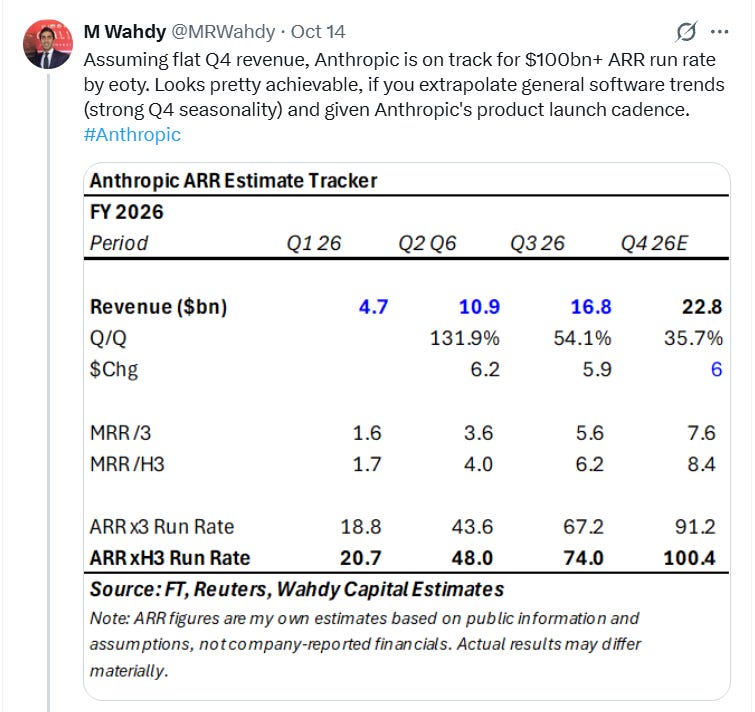
(4) Anthropic’s Q3 annualized revenue run rate came in a bit soft when initially reported in early October. Investors were expecting $100-120bn of ARR by end of 2026, which required something closer to high-70 bn in run rate revenue by the end of Q3. Instead, the number came in at ~$71bn. Our preliminary review was that ARR was still on track for $100bn+ by EOTY. Subsequent WSJ rumors support a higher $110bn+ exit rate. Since then, Anthropic has provided updates, stating that Q3 exit rate ARR was $71bn and moved up to $81bn in October.
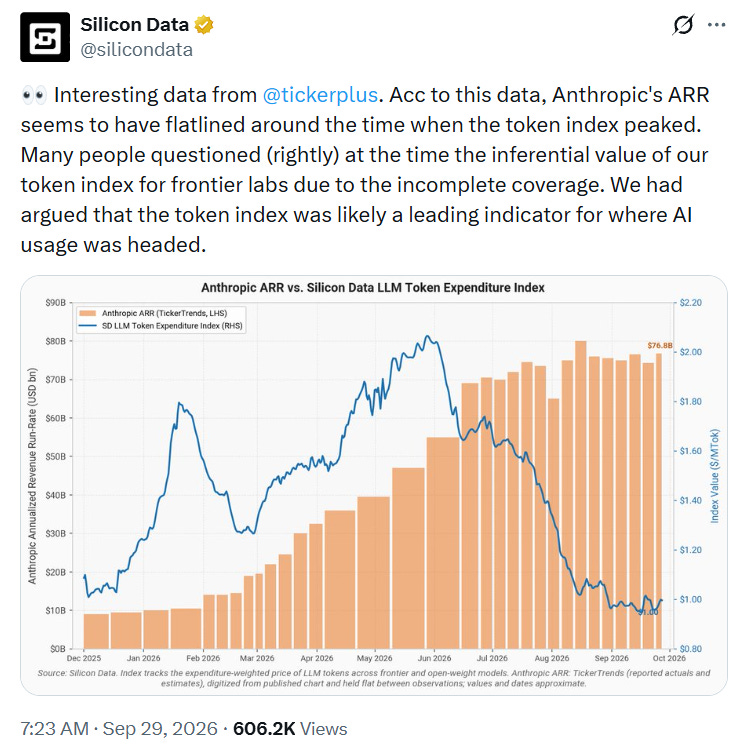
(5) AI Lab growth concerns emerged as data suggests flatlining revenue. Our understanding is that this is due to early renewals in Q3, which also impacted downstream infrastructure software names. Our thesis is that the surge in token consumption in the 1H of the year, combined with the emerging rise of agents (Instinct, Muse, Grokbot, Dots, etc.), drove overage in Q3 which resulted in early customer renewals. While a renewals like this mean a drop in cost-per-token initially, it also implies a healthy RPO boost.
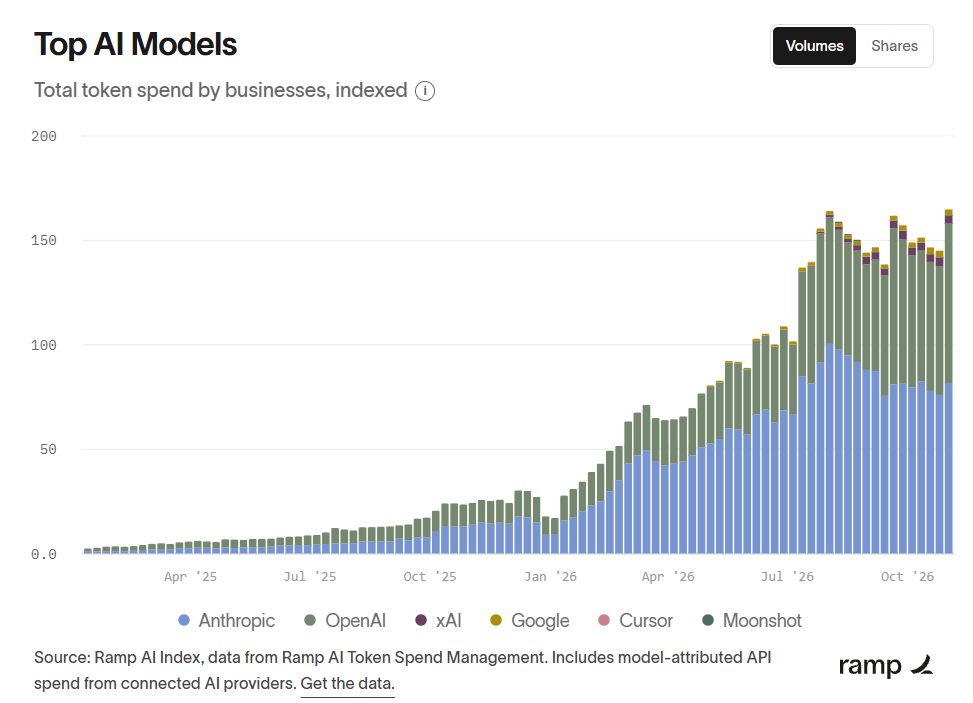
(6) CIO Budget concerns emerging after high profile AI spending cuts. Bloomberg reported cuts to token budgets at Apple and other large companies that suggest AI optimization, similar to the cloud optimizations of 2022-2023. Our review of CTO/CIO surveys indicate IT spending will likely persist at similar rates into 2027. We think there is modest upside in the 1H of the year as hiring improves, with more substantial upside if disinflation in Tech Hardware increases.
(7) Jensen out at NVDA means the “central bank of AI” will likely slow its aggressive push to expand compute capacity globally. Subsequent policy moves from the US Gov (RASA Act, etc.) will likely curtail some deployments globally as export restrictions tighten, limiting the ability for non-US datacenters to sell capacity to Chinese entities.
(8) Rumors of order cuts are probably ahead of the cycle, but with Jensen gone, NVDA’s estimates are at risk given how aggressive he was in placing chips to customers. We expect supply cuts hinted at NVDA’s earnings next week, along with a suspension of their FY 2027 guidance. The ramifications of this is disinflation in chip component costs, which may be a tailwind to AI and Software spend next years as budgets can reallocate.
(9) Anthropic recently showcased how quickly Mythos can port software from one chip to another. Worries over CUDA’s moat have persisted for years and saw an incremental update with Anthropic’s demonstration of porting prompt processing to AMD hardware in three days (versus the 6-12 months it used to take). Lowering switching costs reduces NVDAs power, but we don’t think this particular update necessarily means that CUDA has been commoditized (though that may very well be taking place anyway).
(10) The Democrat sweep in the house, senate, and state houses is an important regime change that will affect the AI ecosystem. However, we are less worried on the pace of AI datacenter buildouts, as supply chain tightness in power markets had already emerged towards the end of last year. On the bright side, we think Dems will continue with the types of BTM-power and profit-sharing arrangements that many datacenter developers had already begun to do.
We think there is real risk that Dems in congress use their power to investigate executives of major companies, especially donors to Trump’s inaugural committee and the White House Ballroom, as quid-pro-quo arrangements. Given the widespread involvement of Tech executives in donating to Trump affiliated projects and entities, we see this as an emerging factor that will gain steam as the new class of Senators and Representatives are sworn in.
Where do we go from here?
Given the poor performance of US Tech Momentum, we’re skeptical that investors will jump back into tech names, unless a major positive catalyst emerges (e.g. AI accelerates dramatically, ROI on AI capex improves, rates fall). And, after a violent degrossing, active managers are likely in capital preservation mode as well.
Yet despite this, a cleaner positioning backdrop, and stabilization in rates markets could boost equities into year end. The catalyst for this will be NVDAs earnings next week. While we think the company will suspend guidance and post a rise in inventory days, there’s also a path to a more constructive outlook with greater clarity on CEO succession and renewed commitments to the “plan” in place (building out ecosystem of clouds, sponsoring OSS models, vendor financing, etc.).
Scenarios: What matters from NVDAs earnings is less about the numbers (though they matter) and much more about the extent management goes to assuage the concerns of investors. If NVDA’s comments are negative, we would expect SPX to outperform NDX into the year-end, as the rotation away from Info Tech and towards defensives accelerates. If the comments are neutral or positive, we can see NDX moving higher incrementally as cleaner positioning creates room for renewed risk-taking.