

The FOMC met this week and left interest rates unchanged, left their guidance for interest rates unchanged, and adjusted their economic assessment of US growth.
Before we take a look at what the Fed said, let’s consider the backdrop:
In the December FOMC, the Fed shifted to “patience” (deferring cuts) with the Fed Funds Rate at 4.25-4.50%. Going into the Fed meeting was fading concern over the health of the economy, primarily stemming from weak jobs data in August. But in the Summary of Economic Projections (released every quarter), the Fed revised growth higher (from 2.0 to 2.1) for 2025 and reduced the number of cuts it expected (from 4 to 2).
By the January/February FOMC meeting, the Fed incrementally shifted hawkishly by removing a reference to inflations progression towards a 2% target. The market saw this as a sign that the Fed would potentially delay Fed cuts even more, and market implied cuts went from ~1.9 pre-FOMC to ~1.7 post-FOMC.
Then, in February, the trade and tariff chaos began. First with a 25% tariff on goods from Canada and Mexico (delayed to April 2) and 10% additional tariff on China, supposedly as a response to the fentanyl crisis. Second, with a restoration of Section 232 tariffs of 25% on steel and aluminum. Third, Trump announced the administration will reveal their reciprocal tariff plan on April 2. We see this as the beginning in a reconfiguring of global trade and supply chains, as part of the de-globalization trends Trump’s first term initiated.
Markets fell as the trade policy and the DOGE agenda drove uncertainty to new highs:
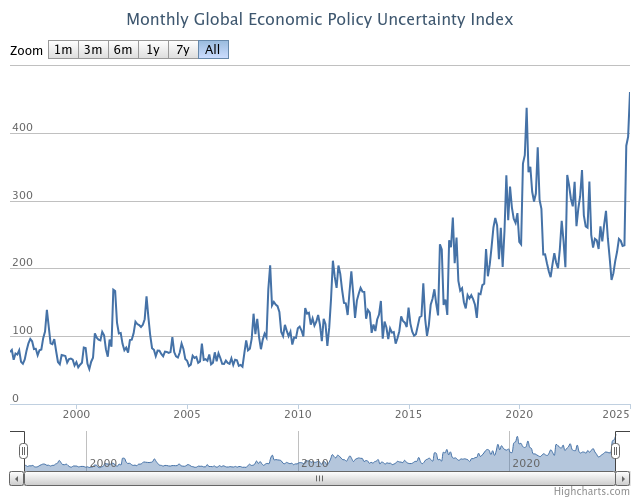
The mechanism for lower equities is through both this years’ earnings estimate (EPS) and the growth rate through the near-term (Multiple). Why would earnings move lower? Aggregate GDP is constructed as equal to the sum of Consumption, Domestic Investment, Government Spending, and Net Exports. Trade restrictions reduce consumption and imports, which reduces fixed investment. DOGE and government budget cuts also imply lower government spending. While the actual impact is yet to be determined, the base case of 2.1%+ growth this year is at risk, with estimates of a 30-40bp drag on growth due to announced policy changes. This means a growth downgrade to 1.7-1.8%, assuming no further action is taken.
However, while economic surprises moved lower through the second half of January and throughout February, the surprises seemed to stabilize in March:
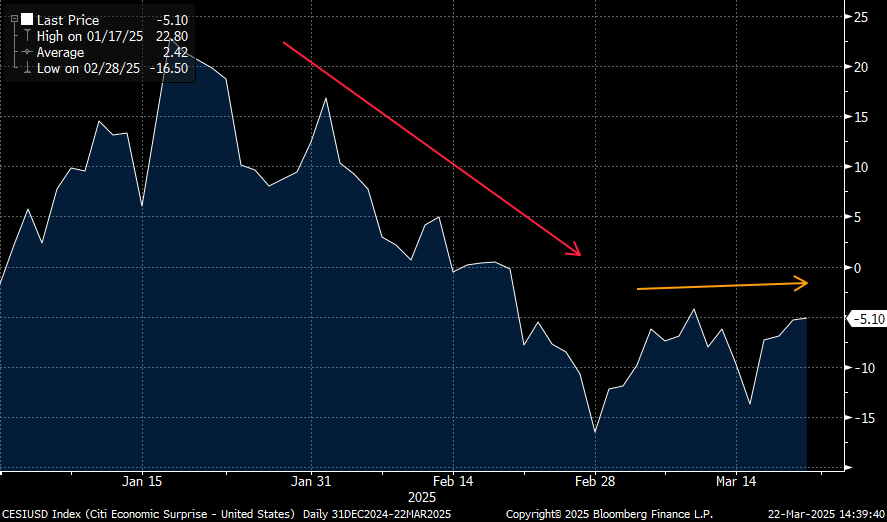
This implies that the data is no longer much worse than expected, and suggests expectations are close to where data is. Fed Funds Futures were pricing in nearly 3 cuts in the run up to the FOMC, though moved down to ~2.4 pre-meeting. Remember, during the Fed’s last Summary of Economic Projections (SEP) they guided to ~2 cuts for 2025.
Pre-event, equity markets had moved down in anticipation of a weaker economy and higher inflation (2-year breakevens), while treasury bonds rallied unevenly.
FOMC Meeting Recap
The Press Release: The Fed left rates unchanged, reiterating their view of continued expansion, with unemployment rate stabilizing, and inflation remaining somewhat elevated. Additionally, the Fed announced their plan to change their Treasury run-off (“QT”) by reducing the monthly redemption cap from $25bn to $5bn. We see this as positive for Treasury market liquidity through a period of heightened uncertainty.
Summary of Economic Projections:
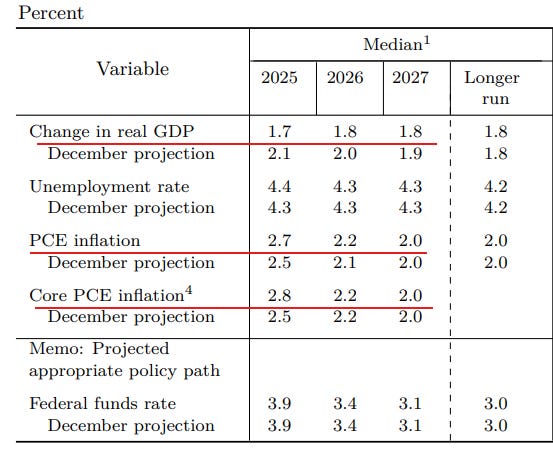
Note the significant 40bp change to growth in 2025, 20bp decline in 2026, and 10bp decline in 2026.
Key takeaways from the Q&A: Powell said that the Fed’s base case is that tariffs are a one-time hit to prices and hence a transitory impact to inflation. This suggests there is room for the Fed to increase its inflation estimates, as we know that the impact of 2018 tariffs saw inflation broadening to even non-tariffed goods. He also countered weak survey data since February, saying “consumer spending [is] moderating a bit, but still at a solid pace” and that “the relationship between survey data and actual economic activity hasn’t been very tight”. Despite this, he did note that the Fed’s current stance is in wait-and-see mode, requiring further clarity on the path of the economy.
In our January letter, we outlined scenarios for the economy:
Upside (15% probability): GDP grows over 2.7% driven by increasing productivity and higher investment from the administration's policy of tax cuts and deregulation. The higher economic activity would push the unemployment rate lower while keeping interest rates above 4%, despite inflation moderating. In this scenario, the resilient economic growth of 2024 would transform into a sustainable mid-2020s growth trend that would move earnings higher and lift the S&P 500 to 7,000+ by the end of 2025, representing a 15%+ delta to current earnings estimates through the '25-'26 period.
Base Case (50% probability): GDP grows 2% as productivity tailwinds in 2024 carry consumption into 2025. Investment would rise modestly on the back of marginally better regulatory and tax regimes, but weakness from Europe and China would limit upside to supply capacity as interest rates remain elevated. Unemployment creeps up from 4.0% to 4.5% by the end of the year, as firms adjust to late-cycle dynamics of boosting margins as nominal GDP cools. Inflation is stubbornly above 2.5% (core PCE), which keeps the Fed still postured for above-neutral rates. Earnings growth is driven primarily by margin expansion, and the S&P 500 ends the year at 6,450, representing a 6% delta to current earnings estimates.
Downside (30% probability): GDP undershoots, growing by 1.5% as productivity gains fail to offset the declines in investment and government expenditures. Unemployment would rise to 4.5% by Q3 as layoffs from the public and private sector gain steam, prompting the Fed to shift policy in early Summer. Interest rates would fall below 4%, though inflation would remain stubbornly above 2.5% (core PCE). The S&P 500, despite seeing some earnings growth, would fall below 6,000 as realized earnings would come in below current estimates.
Crash (5% probability): A mix of trade, immigration, and domestic policy would structurally shift views of growth rate determinants (Solow-Swan variables), moving US growth to sub-1% growth. Inflation would move higher due to trade barriers and decline in the labor force, driving up prices for goods and services. Reductions in government expenditures and workforce would lead to higher unemployment and lower consumption, exacerbating the cyclical declines. Interest rates would trade below 4% but higher inflation would limit the downside. If the policies are seen as holding through to term, then earnings would see significant downward revisions. Note: this is the nightmare scenario.
Our current view of US growth has shifted from 2% to 1.2%:
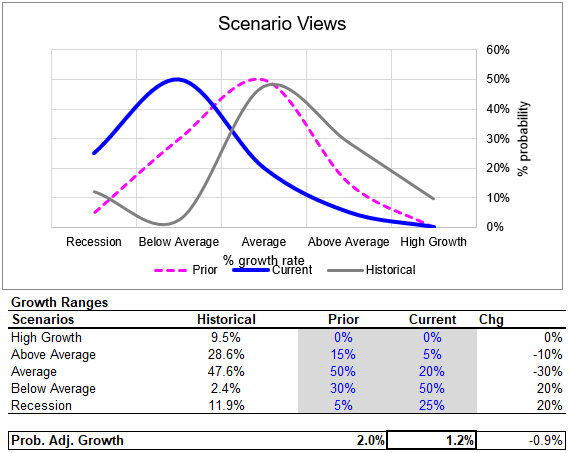
Where do we go from here? From our latest investor letter:
The S&P 500 ended February down -1.3%, reacting to Trump’s announcement of new trade and tariff measures on Canada, Mexico, and China. Coming into the new administration, consensus expected Scott Bessent and Howard Lutnick to temper Trump’s aggressive stance on trade. February, however, proved to be a key learning moment for markets, revealing that Trump’s team appears more focused on securing lower interest rates than preserving growth momentum. This marks a shift in priorities that makes us more cautious on the equity outlook for the remainder of the year. As a result, we are downgrading our earnings growth estimates and see the S&P 500 trading within a 5500-5800 range until trade adjustments are absorbed. Risks are now skewed meaningfully to the downside, as both Trump and Bessent have signaled a willingness to accept “short-term pain”, which we interpret as a higher tolerance for growth detractions, including potential recessionary risks. While we are not explicitly forecasting a recession, economic dynamics are complex and rarely linear.
At the March FOMC meeting, the Federal Reserve held rates steady and released a revised Summary of Economic Projections. Growth expectations for 2025 were downgraded from 2.1% to 1.7%, aligning with the OECD’s recent move, while projections for 2026 and 2027 also saw marginal downward adjustments. In contrast, inflation estimates were revised higher, with Core PCE now expected to end 2024 at 2.8%, while projections for 2026 and 2027 remained unchanged. This suggests that the Fed views the impact of recent tariffs and trade policies as transitory price shocks rather than structural inflation risks. The dot plot was unchanged, maintaining guidance for two rate cuts in 2024, one in 2026, and one in 2027.
The market reaction was sharp. Given the setup, we anticipated an equity rally this week on the back of Fed commentary countering “growth scare” concerns. We don’t expect hard economic data to deteriorate meaningfully until mid-April. Ahead of the FOMC, rate expectations had already shifted lower, with December rate cut pricing moving from 3.5+ cuts earlier in the month to just 2.3 cuts into the meeting. In that context, we expected rates to sell off, the 10-year yield to rise above 4.3%, and the dollar to strengthen, limiting month-end selling pressure from Yen- and Euro-based investors. However, Powell’s press conference drove a dovish shift, with Fed Funds pricing in 2.6 cuts for 2024, the dollar weakening, and the 10-year yield falling to 4.24%. This divergence suggests the market is more skeptical of the Fed’s benign assessment.
Our near-term view remains constructive. We believe upcoming data should support the Fed’s posture, allowing the equity rally to extend into month-end. However, we expect softer economic data to emerge in April, with hard data showing clear signs of slowing by May or June. The key risk to this outlook is that dollar weakness exacerbates portfolio rebalancing flows from Yen and Euro-based investors, which could introduce additional volatility. Given these dynamics, we plan to keep net exposure light, expressing views through tactical macro trades on market rallies if the opportunity presents itself.
In short, slowing US growth paired with improving conditions in Europe and Asia warrants tactical shifts: marginally reducing overall equity allocations in favor of fixed income and cash, while rotating equity exposure from the US toward international markets. We think this better aligns global portfolios to the economic outlook we expect through 2025.
Muhammad Wahdy
Portfolio Manager
Wahdy Capital
This note is provided for informational purposes only and does not constitute investment advice, a recommendation, or an offer to buy or sell securities. Views expressed herein are subject to change without notice based on market or other conditions. Investors should consult their own financial advisors regarding suitability, risks, and consequences of any investment decisions.