

Recap: Federal Reserve cut interest rates today by 25bp citing solid growth, a moderating labor market, and better-but-rangebound inflation rate. While the FOMC’s employment and inflation goals are roughly in balance, they see economic outlook as uncertain. There was one dissent from Beth Hammock, who would have voted for no cut.
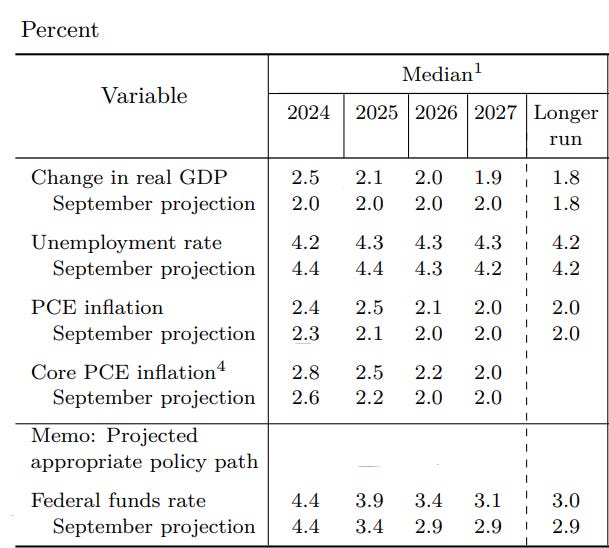
In the Fed’s Summary of Economic Projection (“SEP” and/or “guidance”), they point to higher FY ‘25 GDP offset by ‘27, better balance in the Unemployment Rate, and still-tracking Inflation story moving to 2% by 2027. With Inflation and Unemployment roughly in balance through the projection period, the Fed is suggesting it is close to Neutral.
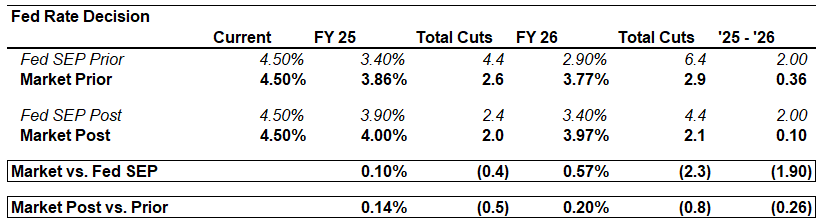
Analysis: Coming into the FOMC meeting, the market was pricing in 1 cut today (Dec 24), 2.6 cuts in FY 25 and 0.4 cuts in FY 26, with a terminal rate of ~3.7%. The Fed’s decision today was in-line with market expectations for Dec ‘24, Dec ‘25, but is 2 cuts more than the market was implying for Dec ‘26. After the press conference, the market ended with a terminal rate at ~4% up from ~3.7%.
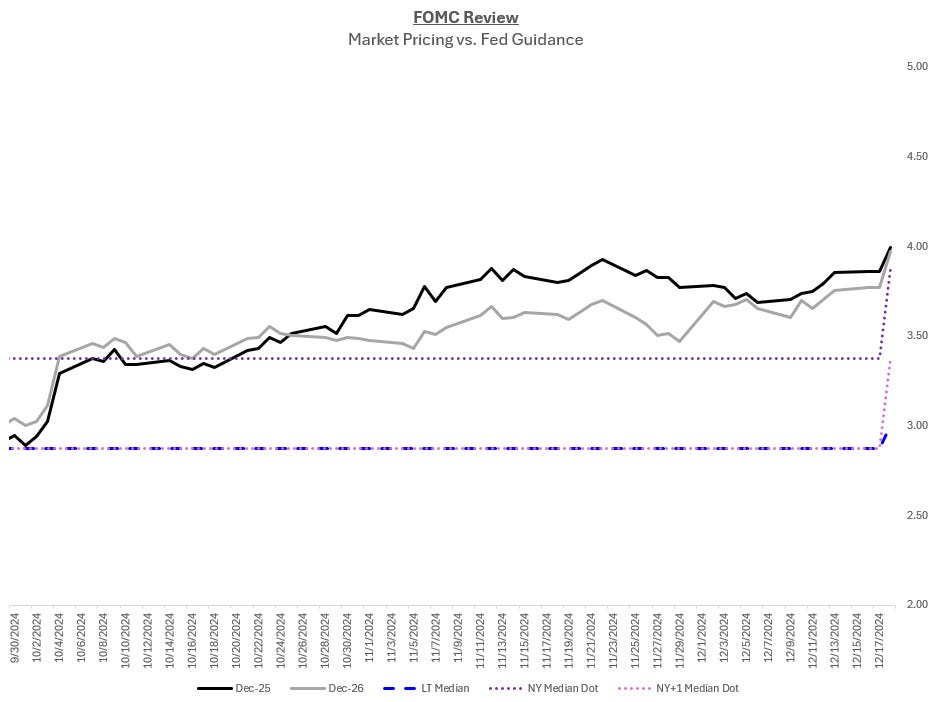
Our View: This was a “Dovish” cut in that the Fed’s guidance came in below market expectations. However, during the press conference, Fed Chair Jay Powell indicated that policy is entering a new phase, which is perceived to be hawkish. We disagree and think that the Fed’s posture is still more sensitive to the labor market outlook than it is to inflation. The market moved the other way and priced out the cut in FY ‘26 to lift the terminal rate from ~3.7% to ~4.0%, effectively “betting against” the Fed’s SEP.
What about the new Administration’s policies?
As Powell noted, it’s hard to say what will actually come to fruition — between wide ranging tariffs and potentially deporting 10m+ individuals and families, there’s a lot that can happen between now and then. What we do know is (1) where the economy is today, and (2) where the contribution of growth from rate sensitive parts of the economy. Unless the economy were to enter into a new regime (where Neutral is above or equivalent to current Fed Funds Rate), it’s hard to see a reacceleration without a significant exogenous shock.
Macro and Cross-Asset Impact:
For Growth, we think a higher terminal rate reduces growth in the near-term and maintains pressure on interest rate sensitive sectors (housing, industrials, autos, etc.). We expect manufacturing PMIs to remain range bound below 50, with services growth partially offsetting those declines.
In Rates, we think the initial bear-flattening (when the front end of the curve sells off faster than the long end) continues into deeper flattening. The path of unemployment is a very important signal, as our analysis suggests the degree of labor market cooling is sufficient to keep the Fed tilting towards cuts. We see some value in duration with the 10Yr at +4.5%.
For Equities, we expect estimate revisions on interest rate sensitive sectors to continue to weaken, though a higher terminal rate should boost NIM in financials. Risk assets may see a small correction of 5-10% if bear-flattening persists.
Muhammad Wahdy
Portfolio Manager
Wahdy Capital
Learn More | Investor Letters